

Angular misalignment and lateral offset
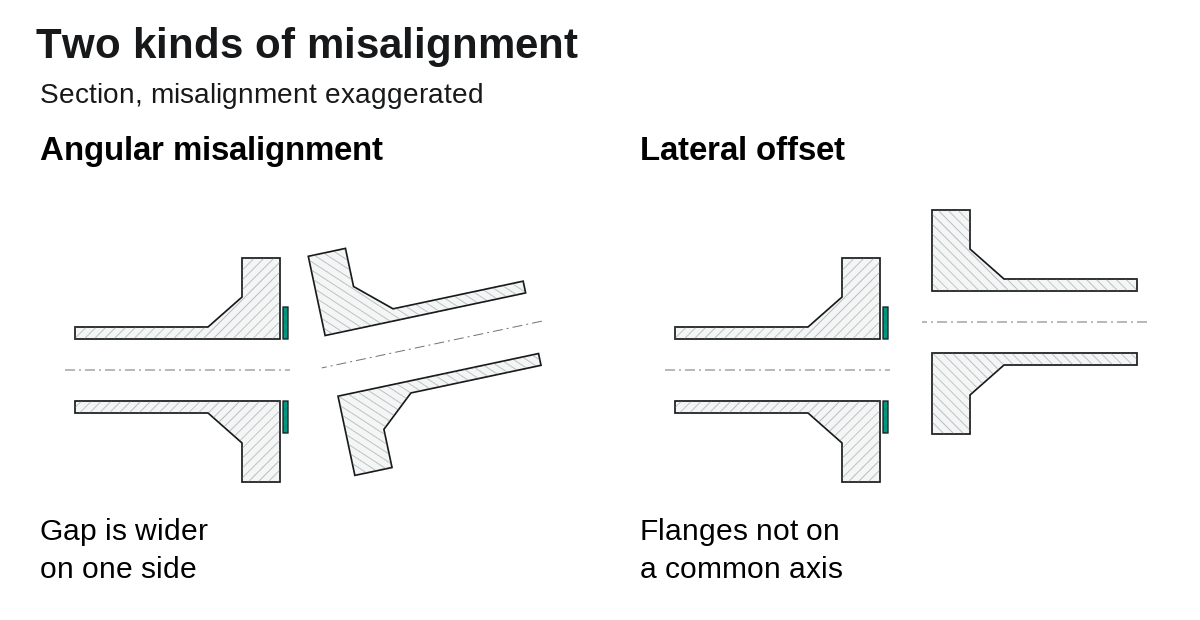
- Angular misalignment (lack of parallelism). The faces sit at an angle to each other and the gap is wider on one side. The gasket is compressed more on the narrow side than on the wide side.
- Lateral offset. The flanges are not on one axis; the bolt holes and the gasket are not centred. With severe offset, the bolts cannot be inserted without force; with moderate offset, assembly is possible but the gasket is loaded asymmetrically.
Both conditions affect how the gasket is compressed. Angular misalignment acts directly on how evenly the contact stress is spread round the circumference.
Why tightening does not fix alignment
With angular misalignment, bolt force reaches the gasket first on the narrow side, while too little stress may arrive on the wide side. When the bolts reach their target, the total load may be right but its distribution is not: one side can be crushed beyond what the material recovers from, the other may never reach the stress needed to seal. Under pressure or thermal cycling, the under-compressed sector tends to become the leak path.
Do not pull the pipework into position with the bolts unless a prescribed alignment procedure allows it. Doing so adds bending stress to the pipe, welds and connected equipment; pumps and vessels have permissible connection loads set by their manufacturers, and forcing flanges together can exceed them even if the joint seals at first.
What the removed gasket can show
A one-sided or crescent-shaped compression mark: check flatness, alignment, seating and assembly — the pattern alone does not identify the fault. An off-centre mark: check size, positioning, retention and possible radial movement. A partial or broken ring, or a gasket found displaced from where it was fitted, also points to the assembly geometry.
If the same non-uniform pattern appears on gasket after gasket, a recurring alignment problem is more likely than a wrong grade.
Where misalignment comes from
- Sag. Long, poorly supported runs can sag between supports and tilt the flange at the end.
- Thermal expansion. Aligned when cold can mean offset when hot, if supports or room to expand are missing.
- Settling supports. The pipe moves with its supports, sometimes gradually.
- Component or equipment. An angular error can be built into a spool; connections on pumps and vessels can move under operating load and temperature.
Checks before assembly
- Gap all round. Before inserting the gasket, measure the gap at several points round the circumference — for example at four evenly spaced positions — with feeler or taper gauges. An even gap indicates parallel faces.
- Bolt holes. The bolts should go in without force.
- Do not pull with the bolts. If alignment needs bolt force, first establish the permissible geometry and the alignment procedure; correct supports, spool lengths and brackets as specified.
- Tolerances. Permissible deviations come from the project specification, the applicable code and the equipment documentation — not from judging by eye.
If a joint keeps leaking after correct replacement with a suitable grade and load, assess the alignment at that joint before fitting the next gasket.
Frequently asked questions
Can I align offset flanges with the bolts?
Not without a prescribed alignment procedure. Permissible geometry, alignment forces and connection loads come from the specification and the equipment documentation.
How do I check parallelism?
Before inserting the gasket, measure the gap at several points around the circumference, for example with feeler gauges. Permissible deviations come from the specification and the equipment documentation.
How does misalignment show on the removed gasket?
A one-sided or off-centre compression mark can give clues. The pattern alone does not identify the fault; check flatness, alignment, seating and assembly together.
Does more torque help?
More torque does not replace permissible alignment. Re-tighten only to the assembly instructions, with the joint cool and depressurised, by a competent person.